সমাজ কল্যাণ পরিষদ
A trusted development partner for rural Bangladesh
Since 1982, SKP has designed and delivered livelihoods, health, water and rights programmes with government and development partners, putting rural women and the poorest families at the centre.
Download our organisation profile(PDF, 1.4 MB)Since 1982
From one district in Kushtia to communities across Bangladesh.
Samaj Kalyan Parishad (SKP) is a non-government, non-political, non-profit voluntary organisation founded in Kushtia in 1982 by Md. Abdus Samad. We work with helpless, landless and powerless people, regardless of caste, race, sex or religion, with a particular focus on widowed and divorced women, adolescent girls and children.
Every programme begins with a baseline survey of what the community needs. We deliver through cooperative groups and grassroots organisations, and we concentrate on areas left behind socially and economically.
SKP has 102 staff and volunteers, its own 23-acre campus and training centre in Madhupur, Tangail, and written personnel, financial, gender, and savings and credit policies.
Mission
Improve the socio-economic status of disadvantaged people through institution building, education, training, and moral and economic support, mobilising local resources.
Vision
A society free of starvation, oppression and exploitation, where every person can become the master of their own destiny.
Goal
Organise disadvantaged people to improve their living conditions and build communities free from injustice and exploitation.
In the field
Six programme areas, each delivered through our Development Groups and in partnership with government and donors. Choose an area to see the detail.
Development groups and savings
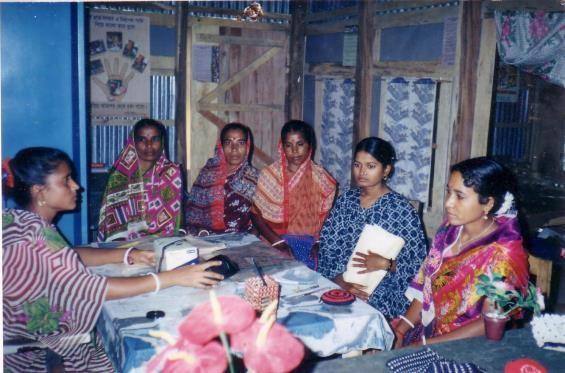
We organise distressed women and vulnerable families into grassroots Development Groups of 25 to 30 neighbours. Members elect a president, secretary and cashier, and set their own savings amount, meeting day and place.
Field workers visit every group each week to collect voluntary savings that members can draw on in an emergency. Our motto: "Today's little save, tomorrow's great help."
Micro-finance and income generation
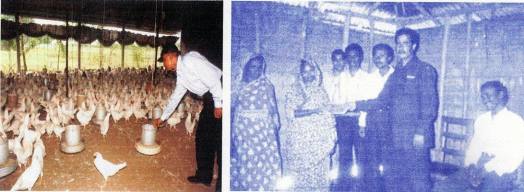
Rural women have no collateral for formal loans and face ruinous rates from moneylenders. SKP offers small loans with training, so members can run cow fattening, poultry, pond fisheries, rice husking, petty trade and handicrafts.
- Groups must be 3 months old; the group selects and recommends each borrower
- Every borrower completes a 3-day course on planning, management and credit
- Repayment in 12 monthly instalments
- 75 women in Madhupur and Tarail produce nakshi kantha and embroidery
Health and nutrition
Satellite clinics with qualified doctors and health assistants serve 10 unions of Madhupur, 7 unions of Kishoreganj Sadar and 25 unions across Ramu, Teknaf, Chakaria and Pekua. Registered women and their young children receive consultations, with free medicine in emergencies.
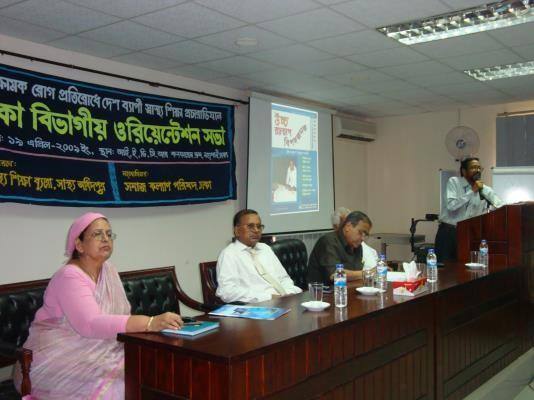
- Nationwide non-communicable disease campaign with the Bureau of Health Education, DGHS
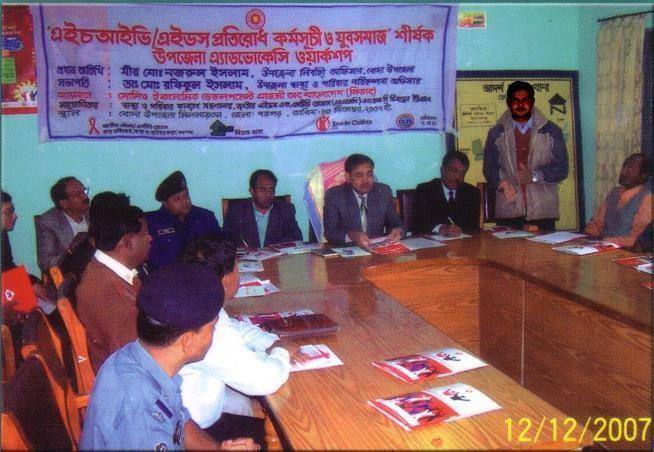
- HIV/AIDS awareness: 20 workshops reaching 500 adolescents, parents, teachers and religious leaders in one year
- Led the ten-NGO Partnership for Community Health, serving 12,500 ultra-poor families
Water, sanitation and hygiene
We install tube wells and sanitary latrines built to work even during disasters, construct school WASH blocks for menstrual hygiene and students with disabilities, and distribute water reservoirs and arsenic-removal filters.
- 15 communities now open-defecation free; 6 with 100% sanitation coverage
- 774 extreme-poor families with improved sanitation; 66 tube wells repaired or installed
- 24 community volunteers trained in PHAST; school hygiene training in 3 schools
Environment, forestation and homestead gardens
Development Group members plant fruit trees such as jackfruit, mango and lychee, along with timber trees and kitchen gardens, on fallow land. SKP provides training, technical support and small grants.
- 1,250 households brought 658 acres under homestead gardening
- 58 village nurseries set up by group members
- Vitamin A-rich vegetables to help reduce night blindness
Education, rights and legal support
We combine literacy, skills and awareness with legal advocacy so that women and children can claim their rights at home and in the community.
- 20 adult literacy centres for 600 learners with Proshika and BRAC; primary centres for drop-out children, mostly girls
- 3,450 women trained in leadership, trades, credit and rights
- 18 three-day rights workshops for 750 women; legal support against early marriage, dowry and violence
- Education and free health care for working children in Chittagong, with ILO-supported advocacy
Also delivered
- Safe water and sanitation (2003–06)Three village sanitation centres with NGO Forum and DPHE, 300 latrine sets and 10 deep tube wells
- Arsenic mitigation (2002–03)Associate in UNICEF's programme in Tangail Sadar
- Disaster preparednessVolunteer network with a medical team for rescue, relief and emergency care
- Disability rehabilitationHealth care, education grants and credit, with the Bangladesh Protibandhi Unnayan Foundation
- Media campaign (2018)National TV campaign on family planning and maternal and child health for the Government
- Government training (2004–05)MCH-FP, hygiene, poultry, duck rearing and handicrafts for the Ministry of Health and Department of Fisheries
The model of change
Everything we do starts with a small group of neighbours who meet, save and decide together. Bottom-up and participatory, every engagement follows the same three steps.
-
Organise
Neighbours form small, homogeneous groups through motivation and education. Unity comes first.
-
Build skills
Members train in leadership, trades, credit management, health, and women's and children's rights.
-
Earn
Savings and micro-finance back income-generating work that gives families a regular income.
Every project also has its own implementation, purchase, and monitoring and audit committees, with quarterly monitoring and half-yearly internal audit.
Proof of change
Results from our Development Group programme in five districts, as of June 2009, and from our health and WASH work.
Who our groups serve
Each dot is 1% of Development Group members.
89%
of the 6,900 members of our 276 Development Groups are women, and women received more than 83% of the micro-finance loans we disbursed.
| District | Members | Savings | Credit |
|---|---|---|---|
| Kishoreganj | 2,575 | 5,435 | 11,640 |
| Cox's Bazar | 2,175 | 5,411 | 12,240 |
| Tangail | 1,000 | 2,393 | 8,532 |
| Jamalpur | 725 | 878 | 4,920 |
| Sherpur | 425 | 1,522 | 3,720 |
| Total | 6,900 | 15,639 | 41,052 |
Our districts
Offices in seven districts, a head office in Dhaka, and WASH communities in Khagrachari. Our 23-acre campus and training centre is in Madhupur, Tangail.
- Dhaka (head office)House 524/A, East Kazipara, Mirpur, Dhaka-1216
- Cox's BazarChakaria (Dulahazra), Pekua, Ramu, Shah Porir Dwip (Teknaf)
- KishoreganjBhairab, Tarail, Kuliarchar, Nikli
- TangailTangail town; Madhupur campus (Jalchatra)
- CumillaDaudkandi, Muradnagar, Homna, Meghna
- JamalpurMatri Sadan Sarak, Jamalpur-2000
- SherpurNakla
- MymensinghPhulpur
Open books
A 21-member General Committee elects a 7-member Executive Committee every two years. The Executive Director leads management and reports to the Executive Committee.
DSW/FDO/R-140Registered 18 April 1983DSW/ER//FD-147/360Registered 10 April 19833/PCFP/KushtiaRegistered 21 October 198202-43979Registered 31 August 2009Executive Committee
- Nelson RemaChairman
- A S M TawhidVice Chairman
- Md. Ashahak AliExecutive Director
- Mst. Naznin AktarDirector
- M A MahbubDirector
- Ahmed Imtiaz JabedDirector
- Mohammad Mobarak UddinDirector
How we stay accountable
- Every project is approved by the Executive Committee before it starts
- Monthly, quarterly, half-yearly and annual implementation plans, with multi-year plans and budgets
- Quarterly monitoring and half-yearly internal audit for every project
- Regular reporting to upazila and district administrations
- Written personnel, financial, gender, and savings and credit policies
- Open information for members, partners and government; withholding it is an offence within SKP
Partners and networks
- Department of Social Services
- Department of Agricultural Extension
- Department of Livestock Services
- DPHE
- Bureau of Health Education, DGHS
- Ministry of Health & Family Welfare
- Bangladesh Red Crescent Society
- UNICEF
- ILO
- BRAC
- Proshika
- NGO Forum
- NGO Education Forum
- Bangladesh Shishu Adhikar Forum
- Partnership for Community Health
- ALRD
- Bangladesh Protibandhi Unnayan Foundation
- Freedom from Hunger
Let's join hands
We partner with government agencies, donors and NGOs to reach the poorest families first. Our Madhupur training centre also runs courses for other organisations' staff.
- Executive Director
- Md. Ashahak Ali
- Phone
- +880 1715-801977
- ashahak@skpbd.org
- Head office
- House 524/A, East Kazipara, Mirpur, Dhaka-1216
- Organisation profile
- Download (PDF, 1.4 MB)